
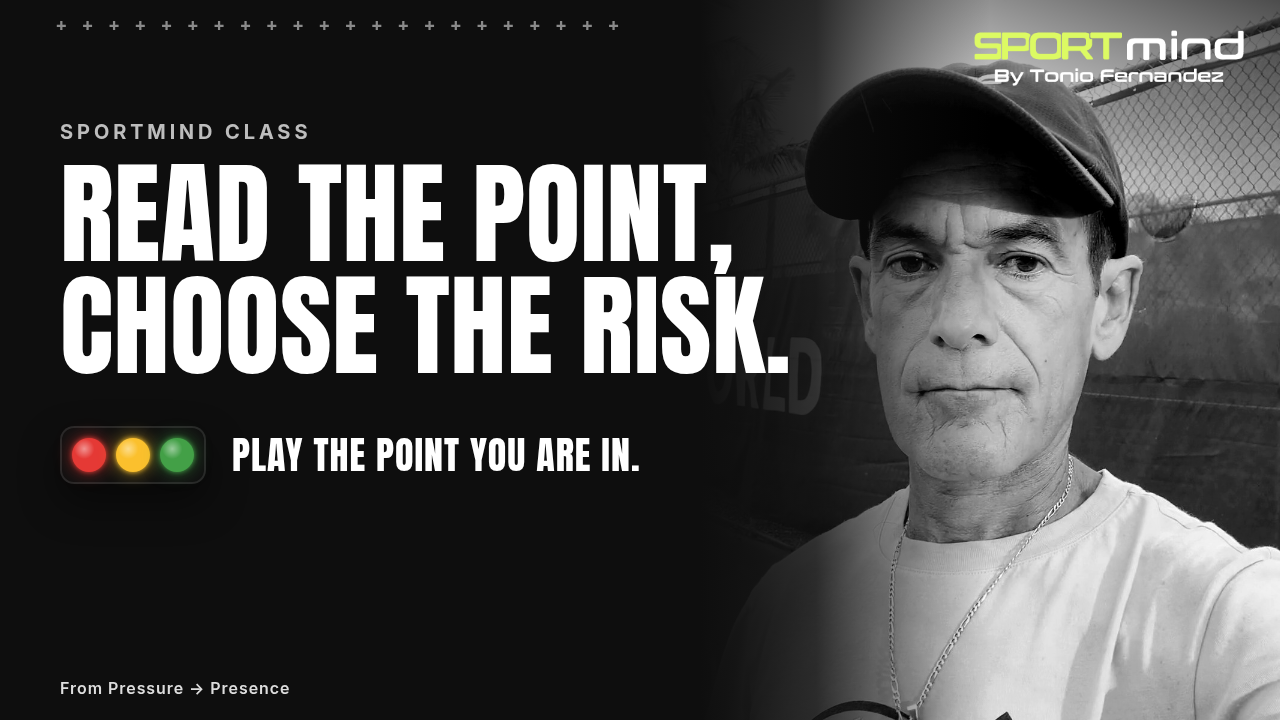
Read the Point, Choose the Risk
Nov 09, 2026By Tonio Fernández · SPORTmind
When was the last time you went for a big shot and realized afterward that the point wasn't asking for it?
Most of us know that moment. We feel frustrated, and we attack. We feel nervous, and we play too safely.
The idea is simple. Before choosing the shot, read your body and the situation. Then choose a clear job for the ball and commit.
If you remember one idea, let it be this: the point gives you information. Your job is to read it, choose, and act.
The path is always the same: Awareness, then Experience, then Action.
The Traffic Light: A Story About Reading the Signals
A young driver was always in a hurry. He sped up when he saw yellow lights and hesitated when the light turned green.
One day, his instructor asked him, "Who is driving the car: you, or your hurry?"
A tennis point also gives us signals. A low or difficult contact, an opponent in control, or a body that feels rushed tells us something. A shorter ball, more time, or an opponent off balance tells us something else.
You can picture the point like a traffic light: red when you are under pressure, yellow when the point is neutral, green when you have an advantage.
The signals don't make the decision for us. They help us see the situation more clearly.
The lesson: Read the light, not your hurry.
Awareness: Read What the Point Is Telling You
In tennis, we often focus on what shot to hit. But first, we need to understand the situation we are in.
Before you choose, notice:
- Your court position. Are you behind the baseline, in a neutral position, or inside the court?
- Your contact and balance. Is the ball low, high, early, or late? Are you organized or rushing?
- Your strength. Which shot or pattern gives you the best chance to create value?
- Your opponent's position. Are they balanced and ready, or moving and recovering?
- The available space. Where is the open court, and how much margin do you have?
Choose: The Job of the Ball
Under Pressure: Defend or Protect
You may be off balance, late, or dealing with a strong ball. The job may be to defend or protect: use more margin, aim for a bigger target, and give yourself time to recover.
Neutral: Build
Both players are organized, and neither has a clear advantage. The job is to build: use a reliable target and shape the point until a better opportunity appears.
Advantage: Create, Transition, or Finish
You may have a shorter ball, a more comfortable contact, or an opponent who is recovering. The job may be to create, transition, or finish. Choose an opportunity that fits your strengths and the opponent's position, then commit to it.
These are guides, not fixed rules. A short ball doesn't mean you must hit a winner. An attacking shot doesn't have to be reckless.
Commit: Why Emotion Chooses Too Early
Many errors begin before the racket moves. We attack because we feel frustrated, or play too safely because we feel nervous. We are responding to our emotion instead of reading the point.
Pressure is information. It can help us notice what is happening in our body and in the point. We can use that information to make a choice.
Three parts of the SPORTmind approach work together here:
- Somatic Dialogue: Notice what your body is telling you before you act.
- Strategist: Read the situation and choose the job of the ball.
- Creator: Commit to your choice and play the point in front of you.
The goal is not a perfect decision every time. It is to become more aware, make a clearer choice, and act with commitment.
Experience: See It, Choose It, Practice It
You don't need a racket or a court to start.
Part A: Imagine the Situation
Picture yourself in the point. Notice your position, your balance, your strongest option, your opponent, and the space.
Try this one:
You are pushed deep and wide. You are reaching for the ball, and your opponent is balanced near the middle of the court.
Ask yourself: Is this a moment to defend, build, create, transition, or finish? What would a suitable target and margin look like?
Now try another:
You are inside the baseline, balanced, and your opponent is moving back toward the center.
Ask yourself: What opportunities do you see? Which one fits your strengths? How much risk makes sense here?
There can be more than one good answer. Connect the decision to the actual situation.
Part B: Notice Your Own Pattern
Remember a recent point when you either went for too much or played too safely. Walk through it slowly, without judgment:
- Where was I on the court?
- How balanced was I?
- What is one of my strengths in that situation?
- Where was my opponent?
- Was my choice based on the point, or on my emotion?
Part C: Take It to the Court
The next time you hit, practice noticing your options as you play. At moments when you have time, ask yourself:
"Where am I? What is my strength here? Where is my opponent? How much risk fits this ball?"
Choose a target and a margin that make sense. Sometimes that means going for more. Sometimes it means building the point.
The aim is not to judge every point by whether it was won. It is to learn what choices are available to you in different situations.
Reflect Afterwards
- What did you notice about the way you choose your shots?
- When are you most likely to rush or hesitate?
- How does your court position affect your options?
- How can you use your strengths to choose a better shot?
- How does your opponent's position change your decision?
- How could this help you during a match?
BFSA for Decisions: A Simple Tool Under Pressure
Use BFSA between points, or whenever you notice yourself rushing into a choice.
- Breathe: Let one complete exhale go.
- Feel: Notice your feet, balance, and level of tension.
- See: Read your court position, the ball, your strengths, your opponent, and the available space.
- Act: Choose the job of the ball, select a target, and commit.
It is not a long pause or a checklist. With practice, it becomes a simple way to return to the point in front of you.
And the cue to carry onto the court:
"Play the point you are in."
Action: Your Practice for This Week
Take a quiet moment with this question:
When the point gets difficult, do I choose the risk the situation calls for, or the risk my emotion is asking for?
Then keep the action small. The next time you hit, notice three points where you have a choice about how much risk to take. For each one, reflect:
- What was my court position?
- What was my strongest option?
- Where was my opponent?
- What choice did I make, and did I commit to it?
Keep the notes simple. You are looking for a pattern, not judging yourself.
Conclusion: Read the Point, Not Your Emotion
Every point gives you information.
When you notice the situation before you choose, you give yourself a moment of presence. Then you can protect when you need to, build when the point is neutral, and take an opportunity when it opens.
You will not always know what the other choice would have produced. You can know whether you read, chose, and committed to the point you were in.
Read the point, not your emotion. Choose the job of the ball, and commit.
If this resonated with you, take the See It, Choose It, Practice It exercise to your next practice and notice what changes. And if you know a player or coach who is learning to make clearer decisions under pressure, share this with them.
From Pressure → Presence
Don't miss a beat!
Ideas and motivation delivered to your inbox.
We hate SPAM. We will never sell your information, for any reason.