
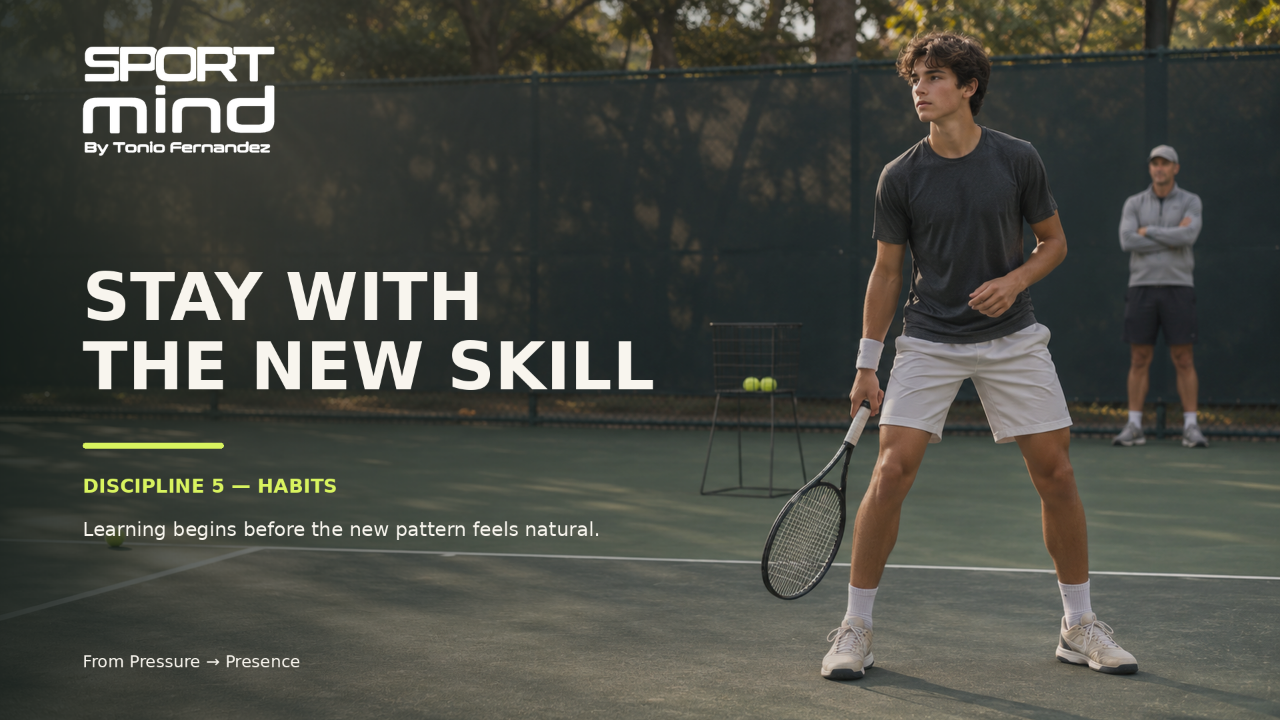
Stay With the New Skill
Nov 16, 2026A player was learning a different forehand pattern.
The first ball felt strange. The second landed short. The third missed long.
Without saying anything, the player returned to the old swing.
The coach stopped the basket and asked, “Did the new movement fail—or did you leave before it had time to teach you?”
The player looked down at the racket. Three attempts had already felt like a conclusion.
The Teaching
When we change a movement, decision, or habit, performance may briefly feel less comfortable. The familiar pattern is deeply rehearsed. The new one still requires conscious attention.
This awkward stage is where many players turn back. They interpret early mistakes as proof that the change does not work.
But a mistake during learning is not automatically a wrong direction. It may be feedback about timing, understanding, tension, or the quality of the repetition.
The question is not only, “Did it work?” The better questions are: “What happened? What can I adjust? Can I commit again?”
Why It Matters
Habits are built through repetition. Courage is required when the new repetition does not yet feel like us.
This does not mean repeating a mistake without thought. Blind repetition can strengthen the wrong pattern. Learning requires a simple rhythm: notice clearly, adjust one thing, and repeat with intention.
The old habit offers immediate familiarity. The new skill asks us to tolerate being a beginner for a little longer.
Practical Experience
Choose one skill you are currently developing. Complete three short sets of ten repetitions.
- After Set One, write what you noticed.
- Before Set Two, choose one small adjustment.
- During Set Three, protect the intention without demanding perfection.
Do not ask whether the skill is finished. Ask whether your understanding became clearer.
Reflection
What do I abandon too early because I mistake discomfort for failure?
Action for the Week
Return to the same developing skill in three practices. Give it ten intentional repetitions each time. After every set: Notice. Adjust. Repeat.
Closing
One attempt introduces a direction. Repeated attention begins to create a path.
Stay with the new skill long enough to learn from it.
From Pressure → Presence
Don't miss a beat!
Ideas and motivation delivered to your inbox.
We hate SPAM. We will never sell your information, for any reason.