
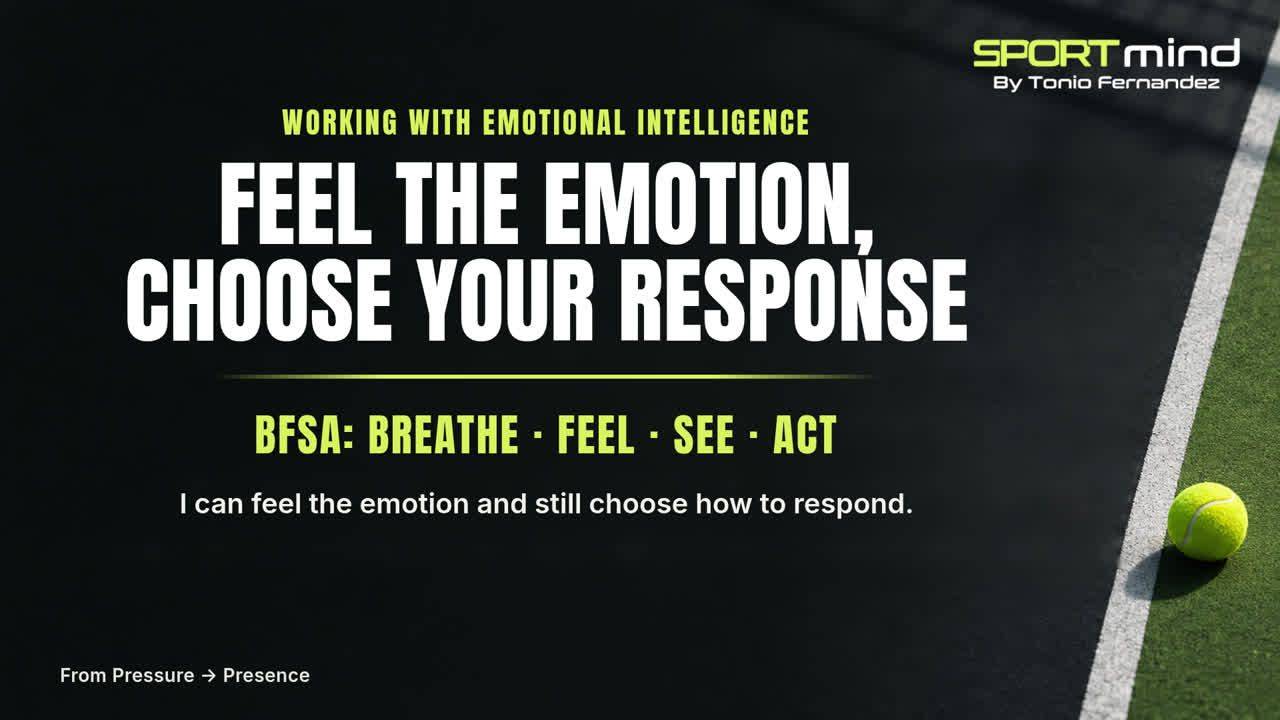
Feel the Emotion, Choose Your Response: Using BFSA in Tennis
Nov 23, 2026By Tonio Fernández · SPORTmind
Think of a point you were still thinking about two points later.
Take a quiet moment and remember it. Where were you on the court? What happened? And what did you carry with you into the next point, and the one after that?
Most players have lived this. The point ends, but something inside us keeps playing it. This week, we work with one simple idea:
I can feel the emotion and still choose how to respond.
The Serenity Prayer
We open this week with a prayer many people know:
God, grant me the serenity to accept the things I cannot change, the courage to change the things I can, and the wisdom to identify one from the other.
Pause with it for a moment before reading on. We will come back to it at the end.
The Point That Stays in Your Head
You and your opponent disagree about the score. You talk it through, and play resumes.
Two points later, you miss a return and realize you're still having the same argument in your head. Your grip is tight, and you barely saw the serve.
So here is the question:
The score was settled. What was the player still carrying?
The disagreement ended on the court. It did not end in the body. The tight grip and the serve you barely saw were not about technique. They were the emotion, still there, still asking for attention.
State Before Strategy
In SPORTmind, we say: state before strategy. Before you decide what to do, notice what state you are in.
That's why we feel the reaction in the body first, before exploring why it affected us. The body usually knows before the mind has an explanation.
To work with an emotional reaction, we use BFSA: Breathe, Feel, See, Act. In this class it unfolds in five steps. Let's walk through all five with the same example, the score dispute.
BFSA in Five Steps
1. Breathe: Identify the Event
Take a comfortable breath. Then ask: What happened that disturbed my peace?
"My opponent and I remembered the score differently."
Just the event. Simple and clear.
2. Feel: Recognize the Emotional Temperature
Ask: What am I feeling? How strong is it, from 1 to 10? Where do I feel it in my body?
"Anger, seven out of ten. My jaw is tight and I'm squeezing my grip."
Naming the emotion and finding it in the body turns a reaction into information.
3. See: Discover the Cause
Ask: Why might it have happened? Why did it affect me this way?
Treat a possible cause as a possibility, not a verdict.
"We may have lost track during a long game. I felt upset because I thought my honesty was being questioned."
Notice there are two layers here: what may have caused the situation, and why it touched you the way it did.
4. Act: Look for Solutions
Ask: What could help with the situation? What could help me work with what I'm feeling?
"I can suggest going through the points together. When play resumes, I can loosen my grip and watch the server."
One solution for the situation, one for yourself.
5. Act: Divide or Share Responsibility
Ask: What is mine to handle? What belongs to someone else? What can we handle together?
"I'm responsible for my tone. We can reconstruct the score together. My opponent is responsible for how they respond."
This is where the Serenity Prayer comes alive on the court. Some things are yours to change. Some are not. Some you share.
Practice: Replay the Moment
Understanding the steps is the beginning. The real learning happens when you practice them.
Choose a moment. Think of a recent tennis incident that still bothers you a little. Not the biggest one; just something that still carries a small charge.
Write it through, in order. Take about ten minutes and go through the five steps on paper:
- Identify the event.
- Recognize the emotional temperature.
- Discover the cause.
- Look for solutions.
- Divide or share responsibility.
Rehearse it standing. Then stand up, feel your feet, and picture the moment. Move through Breathe, Feel, See, Act. Say the words or make the movement you chose: calmly asking to go through the points, or loosening your grip and taking your return position.
The body learns by doing. When the moment comes again, you've already been there.
A Moment to Reflect
Ask yourself:
What did you understand about the situation after noticing where you felt it in your body?
You don't need to share the details with anyone. One honest observation is enough.
Your On-Court Commitment
Complete this sentence, and rehearse it:
"When ___ happens and I notice ___ in my body, I will ___."
In your next practice, use BFSA when that moment arises. After practice, revisit one moment using all five steps.
And measure progress in the right way: not by whether the emotion disappeared, but by whether you noticed your reaction and made a deliberate choice, even if the emotion was still there.
Conclusion: What Can I Accept, and What Is Mine to Change?
Emotions will come on the court. A disputed score, a bad call, a missed return. That's part of the game, and part of being human.
The goal is not to stop feeling. The goal is to feel the emotion and still choose how to respond.
So let's return to the prayer, and to one question you can take into every match:
What can I accept, and what is mine to change?
If this spoke to you, choose one moment from your last match and walk it through the five steps this week. And if you know a player, coach, or parent who carries points long after they end, share this post with them.
From Pressure → Presence
Don't miss a beat!
Ideas and motivation delivered to your inbox.
We hate SPAM. We will never sell your information, for any reason.